Swallowtail Tattoo
Design study for a tattoo studio whose flash wall is made of old natural-history plates.
A design study. Swallowtail Tattoo is a made-up business, so the copy, prices and details are invented to show how the design works.
Overview
Project overview
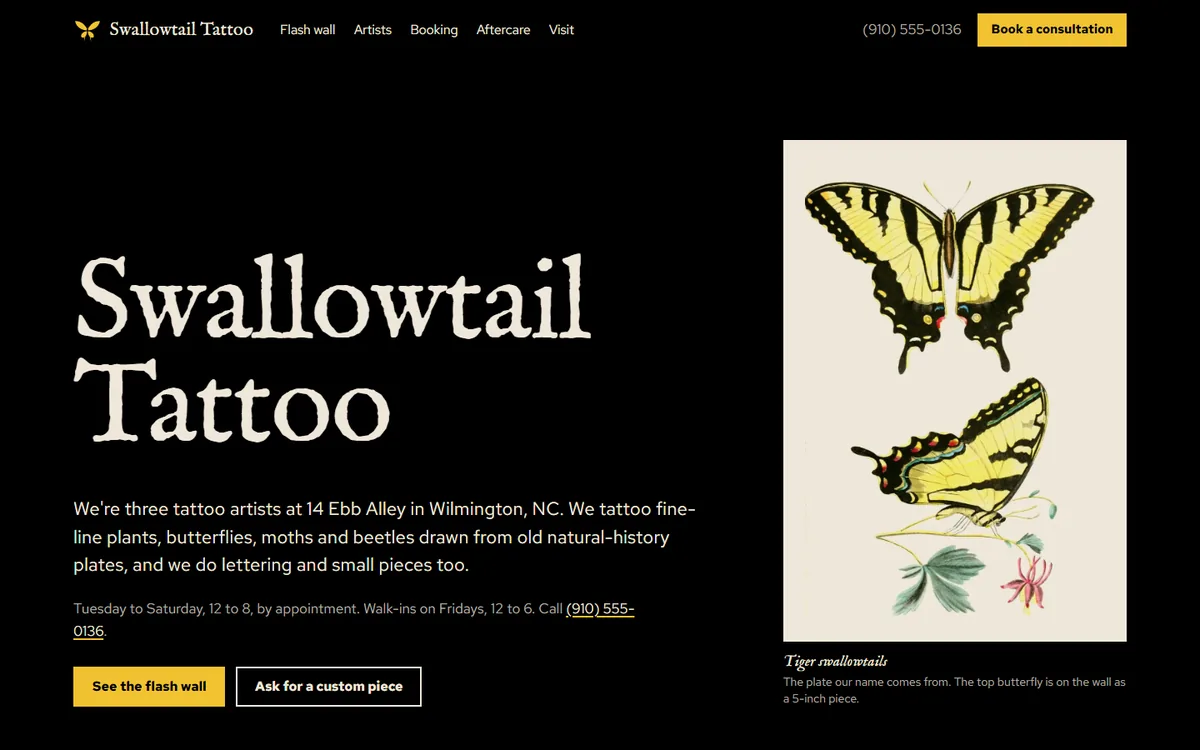
A made-up three-artist tattoo studio in Wilmington that does fine-line plants and insects. The homepage is the studio's flash wall: old natural-history plates of insects and plants on bone paper, every drawing shown at the same scale, each with a price and a button that carries it into the booking form.
Approach
How I approached it
This is a design study for a tattoo studio I made up. Swallowtail does fine-line plants and insects, and people pick a tattoo by looking at flash, so the page is built around a flash wall. Every piece on it is a butterfly, moth, beetle or plant taken from an old natural-history plate. Each one has a size and a starting price, and is marked with the artist who tattoos it.
The wall shows every drawing at the same scale. One column of the grid stands for an inch of skin, so the one-inch Merendera looks small next to the five-inch swallowtail, and a scale bar at the top of the wall shows how big an inch is. The plates came from eight books and many different scans, so I cropped each to a single subject and evened out the paper to one bone color. That makes them look like a single set, the way a studio’s flash would.
The rest of the page answers what people ask before they book: what each of the three artists draws, how the consultation and the deposit work, how to look after a new tattoo day by day, and the rules. “Book this piece” fills in the booking form with that design, so nobody has to describe a drawing they’ve already found.
What was delivered
Deliverables
- A flash wall of 16 pieces taken from plates printed between 1770 and 1915, each with its size and starting price
- Every drawing on the wall shown at the same scale: one column of the grid is one inch on skin, with a scale bar to read it by
- A Book this piece link on every design that fills in the booking form and pins the plate beside it
- Artist profiles with style tags, and filters that highlight one artist's pieces or the ones that can be done as Friday walk-ins
- The booking steps and the aftercare schedule as real day-by-day sequences, with the studio's rules in plain words
Key decisions
- True black walls, with each plate set on bone paper and a small museum label underneath
- IM Fell English, a 17th-century typeface like the captions on old plates, with its italic used for the labels
- Plates from eight different books cleaned up to read as one set, with one paper color and one subject per sheet